Beyond “Bluespace” and “Greenspace”: A Narrative Review of Possible Health Benefits from Exposure to Other Natural Landscapes
Citation
Li, H., Browning, M. H., Rigolon, A., Larson, L. R., Taff, D., Labib, S. M., … & Kahn Jr, P. H. (2023). Beyond “bluespace” and “greenspace”: A narrative review of possible health benefits from exposure to other natural landscapes. Science of the Total Environment, 856, 159292. doi.org/10.1016/j.scitotenv.2022.159292
 Many studies show that spending time in nature can improve both physical and mental health, especially in places with lots of plants (i.e., green spaces) or water like lakes and oceans (i.e,. blue spaces). However, not all natural places fit into these categories. Deserts, mountains, caves, and icy regions are also natural environments, yet they have received much less attention in research.
This review looks beyond color-based labels and suggests that natural landscapes are made up of three basic elements: plants, water, and rocks or minerals (including soil). Some landscapes are rich in plants or water, while others are shaped mainly by ice, stone, or sand. The authors examine evidence showing that these less-studied environments can also offer health benefits, whether people experience them briefly, such as by looking at photos, or over longer periods, such as by living in these places.
Reported benefits include better mood, improved mental well-being, and even support for treating certain health conditions like respiratory conditions or allergies. The reasons these environments may be beneficial are similar to those suggested for green and blue spaces, such as helping people recover from stress or build positive experiences. Other possible reasons include post-traumatic growth, self-determination, supportive environment theory, and place attachment.
Overall, this is one of the first reviews to highlight the health-promoting potential of natural landscapes beyond green and blue spaces. It also points out that classifying nature by color can be confusing and limiting. Because research on deserts, rocky areas, icy regions, and similar landscapes is still limited, more studies are needed to better understand how these environments can support health and well-being.
Abstract
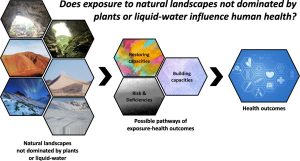
Numerous studies have highlighted the physical and mental health benefits of contact with nature, typically in landscapes characterized by plants (i.e., “greenspace”) and water (i.e., “bluespace”). However, natural landscapes are not always green or blue, and the effects of other landscapes are worth attention. This narrative review attempts to overcome this limitation of past research.
Rather than focusing on colors, we propose that natural landscapes are composed of at least one of three components: (1) plants (e.g., trees, flowering plants, grasses, sedges, mosses, ferns, and algae), (2) water (e.g., rivers, canals, lakes, and oceans), and/or (3) rocks and minerals, including soil. Landscapes not dominated by plants or liquid-state water include those with abundant solid-state water (e.g., polar spaces) and rocks or minerals (e.g., deserts and caves). Possible health benefits of solid-state water or rock/mineral dominated landscapes include both shorter-term (e.g., viewing images) and longer-term (e.g., living in these landscapes) exposure durations. Reported benefits span improved emotional and mental states and medical treatment resources for respiratory conditions and allergies. Mechanisms underlying the health benefits of exposure consist of commonly discussed theories in the “greenspace” and “bluespace” literature (i.e., instoration and restoration) as well as less discussed pathways in that literature (i.e., post-traumatic growth, self-determination, supportive environment theory, and place attachment).
This is the first review to draw attention to the potential salutogenic value of natural landscapes beyond “greenspace” and “bluespace.” It is also among the first to highlight the limitations and confusion that result from classifying natural landscapes using color. Since the extant literature on natural landscapes – beyond those with abundant plants or liquid-state water – is limited in regard to quantity and quality, additional research is needed to understand their restorative potential and therapeutic possibilities.