Street Trees Provide an Opportunity to Mitigate Urban Heat and Reduce Risk of High Heat Exposure
Citation
Ettinger, A. K., Bratman, G. N., Carey, M., Hebert, R., Hill, O., Kett, H., Levin, P. H., … & Wyse, L. (2024). Street trees provide an opportunity to mitigate urban heat and reduce risk of high heat exposure. Scientific Reports, 14(1), 3266. https://doi.org/10.1038/s41598-024-51921-y
 As the climate gets hotter, cities need more green spaces — like parks and street trees — to help keep neighborhoods cooler, healthier, and more livable. Trees can lower temperatures in urban areas, but we need clearer information about exactly how and where they provide the most cooling. This knowledge can help decision-makers ensure that the cooling effects of green infrastructure are shared equitably across all communities.
In this study, researchers measured summer air temperatures along sidewalks in one neighborhood in Tacoma, Washington. They compared these temperatures with the amount of tree canopy close by to see what extent urban trees reduce risks of high summer temperatures.
Across the study area, air temperature varied by 2.57 °C (nearly 5 °F). Areas with no tree cover within about 10 meters (30 feet) were up to five times more likely to reach high temperatures that can pose health risks. Researchers found a simple pattern: the more tree cover, the cooler the air. Even small increases in nearby tree cover made a measurable difference.
These results show how important trees are for protecting people from dangerous heat — especially as climate change brings more extreme summer temperatures. Keeping existing trees healthy and planting more street trees can help cities stay safer, cooler, and more resilient in the years ahead.
Abstract
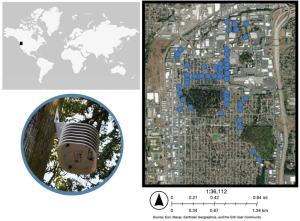
Climate change is exacerbating the need for urban greening and the associated environmental and human well-being benefits. Trees can help mitigate urban heat, but more detailed understanding of cooling effects of green infrastructure are needed to guide management decisions and deploy trees as effective and equitable climate adaptation infrastructure. We investigated how urban trees affect summer air temperature along sidewalks within a neighborhood of Tacoma, Washington, USA, and to what extent urban trees reduce risks of high summer temperatures (i.e., the levels regulated by state outdoor heat exposure rules intended to reduce heat-related illnesses). Air temperature varied by 2.57 °C, on average, across our study area, and the probability of daytime temperatures exceeding regulated high temperature thresholds was up to five times greater in locations with no canopy cover within 10 m compared to those with 100% cover. Air temperatures decreased linearly with increasing cover within 10 m, suggesting that every unit of added tree cover can help cool the air. Our findings highlight the value of trees in mitigating urban heat, especially given expected warming with climate change. Protecting existing urban trees and increasing tree cover (e.g., by planting street trees), are important actions to enhance climate change resilience of urban areas.