Individual and Neighborhood Level Predictors of Children’s Exposure to Residential Greenspace
Citation
Hazlehurst, M. F., Hajat, A., Szpiro, A. A., Tandon, P. S., Kaufman, J. D., Loftus, C. T., … & Karr, C. J. (2024). Individual and Neighborhood Level Predictors of Children’s Exposure to Residential Greenspace. Journal of Urban Health, 1-15. https://doi.org/10.1007/s11524-024-00829-z
 Not all neighborhoods have equitable access to trees, parks, and other green spaces. In the United States, green space inequities are often tied to race and socioeconomic status. Patterns of who has access to green space also varies depending on the geographic area.
In this study, researchers looked at how a wide mix of neighborhood conditions relates to the amount of green space around people’s homes. They used a statistical method designed to measure the combined impact of many factors at once. Researchers also compared how well different types of information—neighborhood factors alone, individual characteristics alone, or both together—could predict how much green space a neighborhood has.
Researchers looked at a sample of over 1,000 mothers and their children from the Conditions Affecting Neurocognitive Development and Learning in Early childhood (CANDLE) study. They measured neighborhood green space in multiple ways: how much vegetation was around each home, how much tree canopy was present, and how close each home was to a park. They also looked at many neighborhood factors, including income levels, education resources, racial composition, and levels of racial segregation.
Overall, the findings show that access to green space is tied to neighborhood socioeconomic conditions, education resources, and racial factors. These insights can help guide policies and programs aimed at ensuring all families have equitable access to the health benefits that green space provides.
Abstract
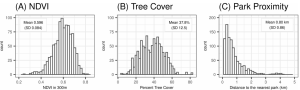
Inequities in urban greenspace have been identified, though patterns by race and socioeconomic status vary across US settings. We estimated the magnitude of the relationship between a broad mixture of neighborhood-level factors and residential greenspace using weighted quantile sum (WQS) regression, and compared predictive models of greenspace using only neighborhood-level, only individual-level, or multi-level predictors. Greenspace measures included the Normalized Difference Vegetation Index (NDVI), tree canopy, and proximity of the nearest park, for residential locations in Shelby County, Tennessee of children in the CANDLE cohort. Neighborhood measures include socioeconomic and education resources, as well as racial composition and racial residential segregation. In this sample of 1012 mother–child dyads, neighborhood factors were associated with higher NDVI and tree canopy (0.021 unit higher NDVI [95% CI: 0.014, 0.028] per quintile increase in WQS index); homeownership rate, proximity of and enrollment at early childhood education centers, and racial composition, were highly weighted in the WQS index. In models constrained in the opposite direction (0.028 unit lower NDVI [95% CI: − 0.036, − 0.020]), high school graduation rate and teacher experience were highly weighted. In prediction models, adding individual-level predictors to the suite of neighborhood characteristics did not meaningfully improve prediction accuracy for greenspace measures. Our findings highlight disparities in greenspace for families by neighborhood socioeconomic and early education factors, and by race, suggesting several neighborhood indicators for consideration both as potential confounders in studies of greenspace and pediatric health as well as in the development of policies and programs to improve equity in greenspace access.