Coding Manual for a Study With the Girl Scouts of Western Washington on the Importance of (Not Just Visual) Interaction With Nature
Citation
Gray, C. E., & Kahn Jr, P. H. (2022). Coding Manual for a Study With the Girl Scouts of Western Washington on the Importance of (Not Just Visual) Interaction With Nature.
 This report explains the method researchers used to analyze stories from a study of Girl Scouts’ meaningful nature experiences. Researchers wanted to understand whether actively engaging with nature (embodied interactions) leads to stronger feelings of well-being than simply observing nature.
Using an interaction pattern approach, they reviewed stories from 127 Girl Scouts, ages 8 to 11, and identified 372 different ways the girls interacted with nature. Examples of embodied interactions included making a snowman, hugging a tree, or talking to chickens. Visual-only interactions included watching snow, noticing moss, or observing a woodpecker. Researchers found that girls who enacted embodied interactions with nature reported a greater sense of Presence, a feeling of deep connection and fulfillment, than those who only looked at nature.
This report shares the coding method in detail so that other researchers can use it to study how people interact with nature and how those interactions relate to well-being.
Abstract
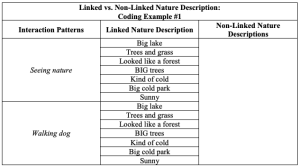
This technical report provides our coding manual – our systematic method to code the qualitative narrative data – from a study of Girl Scouts’ meaningful nature experiences. Other authors on this study (but not on this coding manual) include Joshua J. Lawler, Pooja S. Tandon, Gregory N. Bratman, Sara P. Perrins, and Frances Boyens. Our research question was whether children’s nature interactions that are embodied (vs. only visual) would be associated with eudemonic wellbeing. Using the interaction pattern approach detailed in this coding manual, we coded written narratives from 127 Girl Scouts (8-11 years old) about a recent meaningful nature experience, and, through a novel questionnaire, assessed Presence, a eudemonic state of wellbeing. A total of 372 interactions patterns were coded from the Girl Scouts’ written narratives. Participants who enacted embodied interactions with nature (e.g., “making snowman,” “wrapping arms around tree,” “talking to chickens”) experienced a greater sense of Presence than participants whose interactions relied solely on vision (e.g., “seeing snow,” “seeing moss,” “watching pileated woodpecker”). This technical report provides open access to our core intellectual qualitative work on this project, and can be used by others seeking to employ an interaction pattern approach, or more generally seeking to characterize people’s interactions with nature.